This summary distills Al Brooks’ key concepts from his trading course on how markets behave and how traders can apply probabilistic and structural insights to improve their trading effectiveness.
The focus is on understanding market types, the importance of probability, managing trades systematically, and adopting default trading plans when uncertain. Brooks emphasizes that price action and market behavior always override intuition or expectation.
1. Market Behavior and Structure
Al identifies four fundamental market states, each defining what traders should expect and how they should approach trades:
- Strong Breakout: A sharp, directional move in price representing a dominant trend.
- Tight Channel: A type of strong breakout characterized by a narrow, well-defined channel.
- Broad Channel: A wider price channel allowing larger moves against the main trend.
- Trading Range: Price oscillates sideways within a range, without a clear directional bias.
Key points about market states:
- Strong breakouts constitute about 5-10% of the bars on a chart.
- The majority of the market—about 90% of bars—are in channels or trading ranges.
- Tight channels represent strong breakouts on a higher timeframe scale.
- Broad channels generally allow trading in both directions due to their sizeable retracements.
- In trading ranges, buying low and selling high is the core strategy.
2. Trading Strategies Based on Market Condition
Trading tactics must adapt to the market’s current condition:
- Strong Breakout or Tight Channel:
- Trade only in the direction of the trend.
- Countertrend trading is generally unfavorable here.
- Broad Channel:
- Trade primarily with the trend, but countertrend scalping is possible.
- Trading Range:
- Focus on buying at lows and selling at highs, often for scalps.
3. The Trader’s Equation and the 40-60 Rule
Al Brooks introduces a core probabilistic insight known as the 4060 rule:
- For roughly 90% of bars on any chart, the probability that price moves up or down next is between 40% and 60%.
- This implies most bars do not exhibit strong directional conviction.
- This probability range means that traders can profitably structure trades either long or short about 90% of the time, assuming good trade management.
- Only around 10% of bars correspond to high-probability strong breakouts, which justify directional-only trades.
Implication: Success depends on recognizing when to trade with high confidence (in breakouts) and when to use balanced probability trades (channels and ranges).
4. Price Action and the Reality of “Price is Truth”
A major theme Brooks stresses is the imperative for traders to accept what the market tells them regardless of expectations:
- If the market behaves contrary to your hypothesis or instinct, you must acknowledge the price movement as truth and adjust accordingly.
- Persisting in denial often leads to the “pain trade”—losing money because the trader refuses to accept market reality.
- Example signs of changing market sentiment include:
- Consecutive bear bars closing near lows with increasing bear bar body size indicate a likely downside move.
- Conversely, multiple bull bars breaking higher signal bullish continuation.
- When low-probability moves unfold, traders should switch their stance to align with the price action, despite prior probabilities.
5. Chart Examples and Key Price Patterns
- Bull Microchannel: Series of bars with no significant pullbacks, indicating strong buying pressure.
- Bear Reversal: Emerging after several bearish bars confirming the downtrend.
- Bear and Bull Flags: Patterns after strong breakouts signaling continuation.
- Head and Shoulders Bottom: Major reversal pattern confirming trend change after a strong breakout.
6. Risk Management and Trade Entry
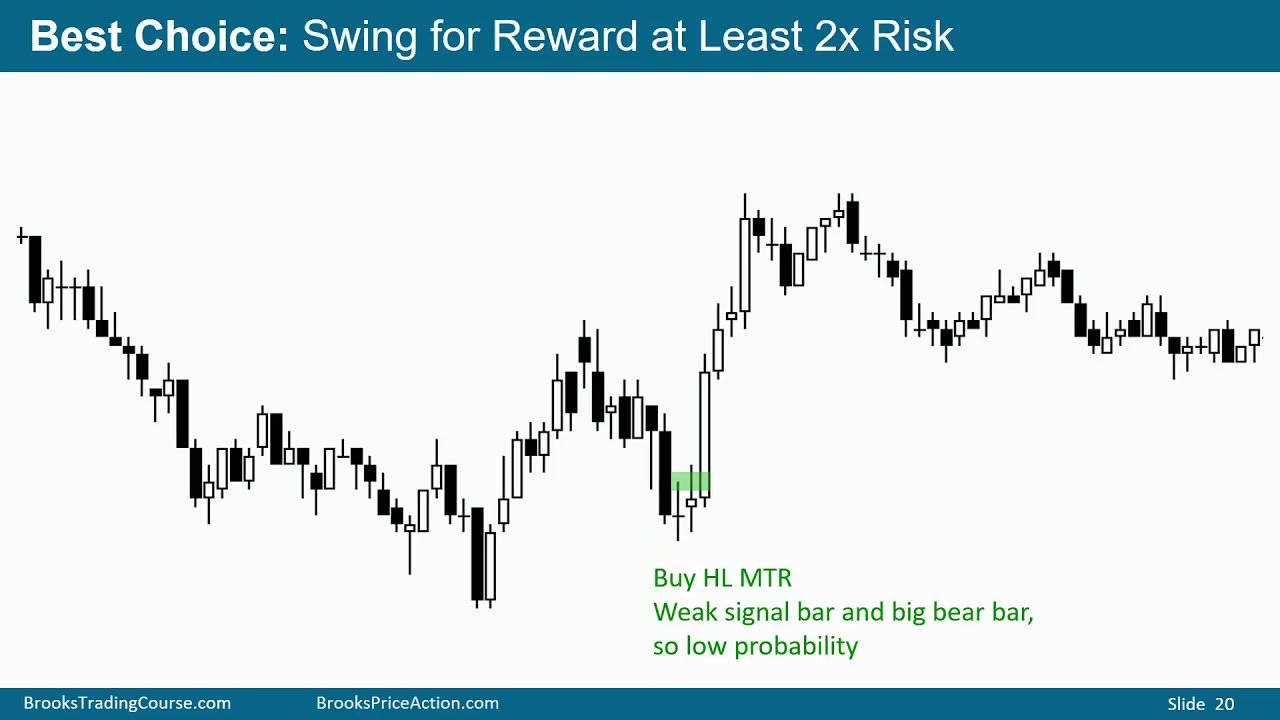
- Trade entries near major highs or lows offer small risks and large reward potential.
- Stop placement is often just beyond the high or low of a signal bar.
- Low probability trades require a greater reward-to-risk ratio, typically aiming for a profit target at least two times the actual risk.
Higher probability trades (e.g., breakouts) offer smaller relative reward distances but higher win rates.
How to make money trading

